

You don’t need a formal test to figure out your attachment style. Your everyday patterns like how you text, love, distance, argue, and connect already tell the story.
Attachment theory says your early caregiver relationships shape your tendency to form bonds in adulthood. Four main styles exist: secure, anxious/ambivalent, avoidant, and disorganized.
(Verified in major psychological references.)
Below, you’ll see 4 sections. Read each one.
The one that feels eerily accurate?
That’s probably your attachment style.
Let’s go.
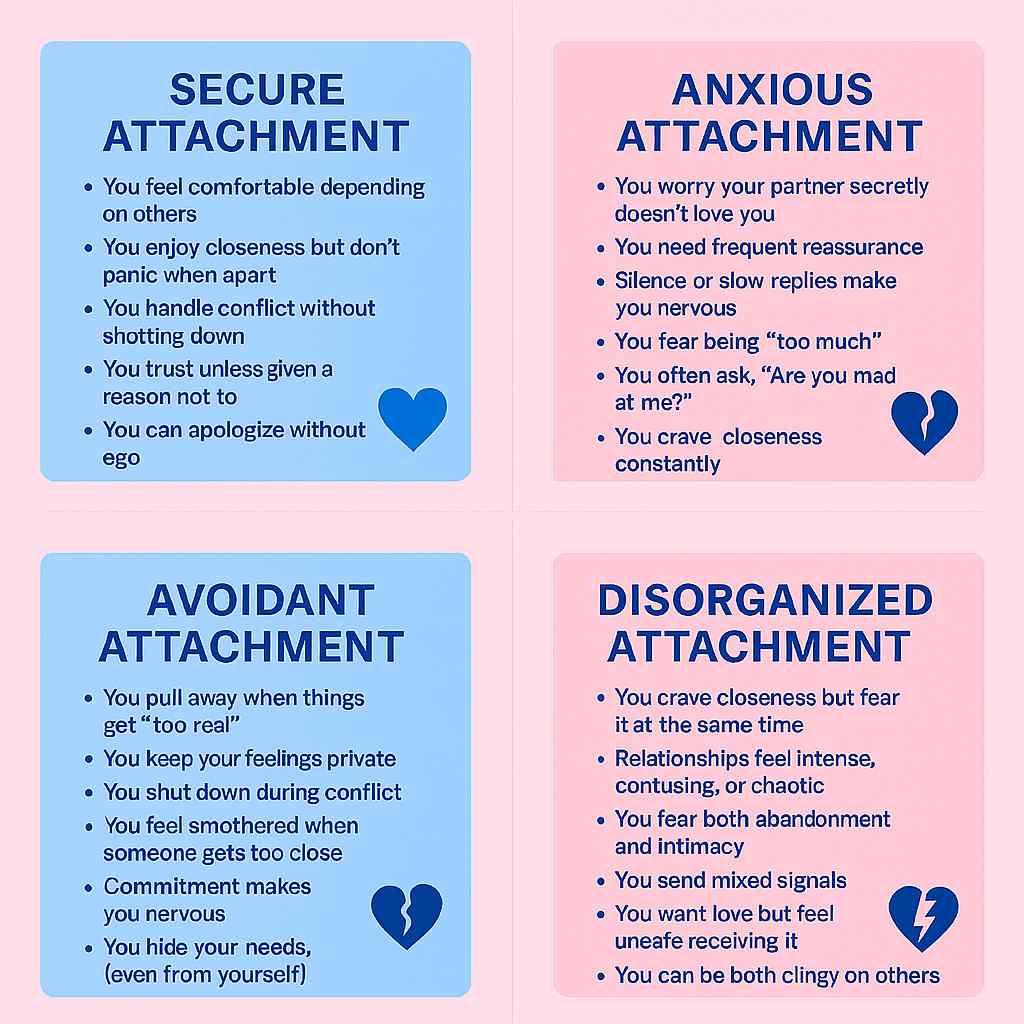
You Might Have a Secure Attachment Style If You…
Secure attachment is marked by trust, emotional openness, and comfort with intimacy.
(Choose ~15–20 things that feel like “yes, that’s me”)
- You feel comfortable depending on others
- …and letting others depend on you
- You’re good at asking for help
- You feel safe expressing emotions
- You enjoy closeness but don’t panic when apart
- Your relationships feel stable, not chaotic
- You handle conflict without shutting down
- You trust easily unless given a reason not to
- You believe you’re lovable
- You believe others can be trustworthy
- You don’t overthink small changes in tone
- You can soothe yourself during stress
- You don’t need reassurance every 5 minutes
- You’re supportive without losing yourself
- You’re emotionally aware
- You can apologize without ego
- Commitment feels natural, not scary
- You communicate needs clearly
- You respect boundaries: yours & theirs
- You tend to create healthy, long-term bonds
You Might Have an Anxious (Ambivalent) Attachment Style If You…
Anxious attachment involves intense fear of abandonment and hypersensitivity to relationship changes.
- You worry your partner secretly doesn’t love you
- You need frequent reassurance
- You think about the relationship a lot
- Silence or slow replies make you nervous
- You get attached quickly and deeply
- You fear being “too much”
- You often ask, “Are you mad at me?”
- You notice every tiny shift in tone or behavior
- You feel unsafe when emotionally distant
- You replay conversations in your head
- You fear being left behind
- Breakups hit you extremely hard
- You tend to date emotionally unavailable partners
- You crave closeness constantly
- You give more than you receive
- You feel insecure when needs aren’t met
- You struggle to be alone
- Emotional highs and lows feel normal
- You may feel jealous easily
- You don’t fully trust that love will stay
You Might Have an Avoidant Attachment Style If You…
Avoidant attachment is built around emotional independence and discomfort with vulnerability.
- You value independence more than closeness
- You pull away when things get “too real”
- You keep your feelings private
- You shut down during conflict
- You avoid deep emotional conversations
- You feel smothered when someone gets too close
- You need lots of personal space
- Commitment makes you nervous
- You prefer casual over serious relationships
- You get uncomfortable when someone depends on you
- You feel safer alone than vulnerable
- You see intimacy as losing control
- You fall for people… once they stop chasing you
- You hide your needs (even from yourself)
- You downplay emotions — yours & theirs
- You’re more logical than emotional
- You might be labeled “emotionally unavailable”
- You feel guilty or pressured when showing affection
- You may choose work or hobbies over relationships
- You fear being trapped, not abandoned
You Might Have a Disorganized Attachment Style If You…
Disorganized attachment mixes anxious + avoidant traits, often rooted in inconsistent caregiving.
- You crave closeness but fear it at the same time
- Relationships feel intense, confusing, or chaotic
- You send mixed signals (even unintentionally)
- You want love but feel unsafe receiving it
- You fear both abandonment and intimacy
- You get overwhelmed by emotions quickly
- You may feel unpredictable or inconsistent
- You might withdraw suddenly
- You trust people… then distrust them instantly
- You replay trauma in relationships
- You fall hard, then push people away
- You struggle to identify your needs
- You fear being hurt or betrayed
- You don’t feel safe relying on others
- You can be both clingy and distant
- Arguments feel threatening, not solvable
- You often say “I don’t know what I want”
- You crave deep connection but avoid vulnerability
- Emotional regulation is difficult
- You often feel overwhelmed by love itself
This article goes deeper into what this looks like in practice: Attachment Styles 101: Why You Love the Way You Love
So… What Is Your Attachment Style?
If most of your signs match one section: that’s your style.
If you matched two: you might have a blended or shifting style.
If you matched three or more: trauma, stress, or inconsistent relationships may be influencing your patterns.
“What is my attachment style?”
Just remember what experts emphasize: Attachment styles aren’t fixed. You can change.
Your patterns are learned, not destiny.
You may find this article helpful as a next step: Attachment Chemistry: What Happens When Styles Mix?

